
Patient story: This account is anonymized and shared with patient verification. Recovery varies by injury, treatment, and individual circumstances.
An active patient, an unexpected injury
Soccer requires acceleration, rapid changes of direction, and forceful push-off from the calf and Achilles tendon. A partial tear can interrupt these movements and make walking, climbing stairs, and returning to sport difficult. For this patient, the injury raised an important question: how could the tendon be assessed carefully and treated with a plan that respected both the injury and his goal of returning to activity?
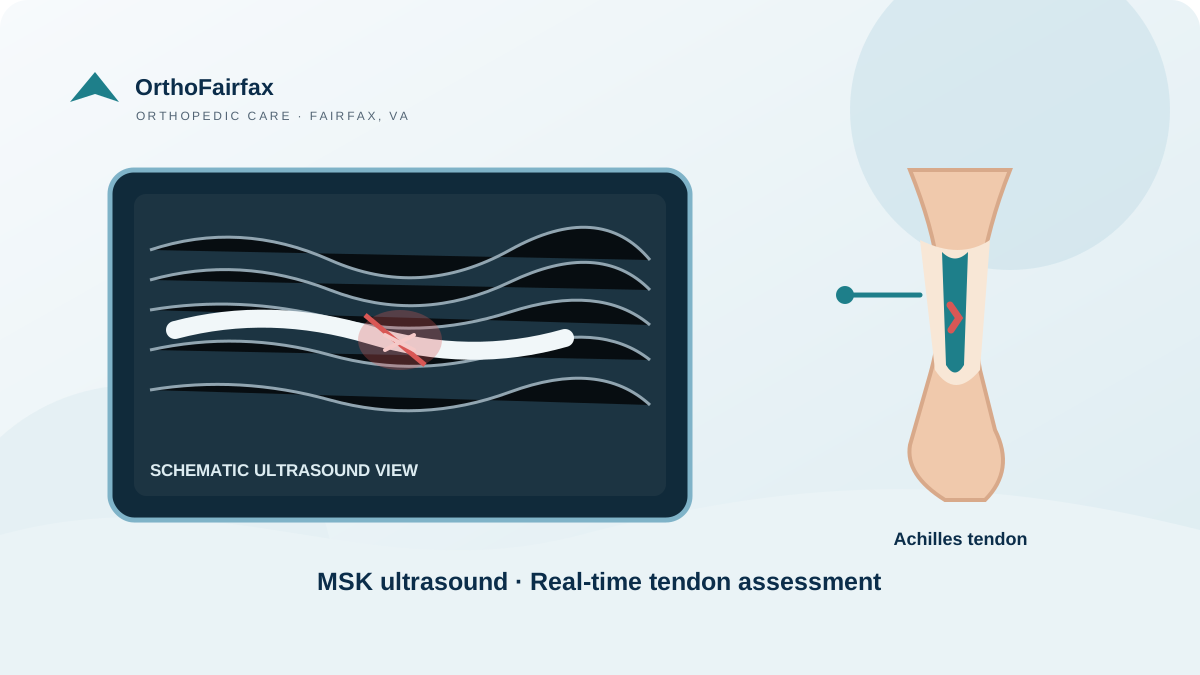
MSK ultrasound: seeing the tendon in real time
Musculoskeletal (MSK) ultrasound is especially useful in many tendon assessments because it provides real-time images of accessible soft tissues. For suspected Achilles injury, ultrasound can help the clinician evaluate tendon fiber appearance, thickening, surrounding fluid, and the extent and location of a suspected tear. Dynamic assessment can add information during movement. The findings must be interpreted alongside the physical examination and injury history; additional imaging or urgent specialist assessment may be needed when the diagnosis or extent is uncertain.
At OrthoFairfax, MSK ultrasound is an important part of the practice's sports medicine toolkit. It can help distinguish tendon disorders, support treatment planning, and guide selected injections when appropriate. Imaging is not a substitute for clinical judgment, and a suspected complete rupture requires prompt assessment because treatment decisions can be time-sensitive.
A plan built around the injury—not a one-size-fits-all protocol
In this case, the practice reports using PRP alongside conservative care. Conservative management for selected partial Achilles tears may involve protecting the tendon, modifying activity, using appropriate support, and progressing rehabilitation in a structured way. The plan must reflect tear severity and location, strength, walking ability, overall health, and sport demands. Some Achilles injuries require surgical consultation; patients should not self-diagnose a partial tear or start loading exercises without guidance.
The role of PRP
PRP is prepared from a patient's own blood to concentrate platelets and associated signaling proteins. It is used in selected orthopedic and sports medicine treatment plans. Research on PRP for Achilles tendon injuries is still evolving, and results vary across studies and treatment protocols. The patient's reported recovery is encouraging, but one case cannot prove that PRP alone caused the outcome or predict results for another person. The strength of the plan lies in matching diagnosis, treatment, protection, rehabilitation, and follow-up—not in promising a guaranteed result from one procedure.
A reported full recovery—and the importance of follow-through
According to the practice's account, the patient made a full recovery. That is the outcome reported for this individual, not a typical-result guarantee. Achilles recovery requires appropriate progression and reassessment. Returning to soccer too soon can risk reinjury, so return-to-sport decisions should be based on clinical progress and guidance.
When to seek prompt evaluation
A sudden pop behind the ankle, rapid swelling or bruising, marked weakness, difficulty pushing off, or inability to walk normally can signal a significant Achilles injury. Seek prompt medical assessment rather than trying to play through it. Early diagnosis helps determine which treatment path is appropriate.
Orthopedic and sports medicine care in Fairfax, Virginia
OrthoFairfax combines orthopedic evaluation, MSK ultrasound when useful, and individualized non-surgical treatment planning for selected musculoskeletal problems. For tendon injuries, that means identifying what is injured, explaining the options, and building a realistic plan around the patient's functional goals. PRP is one tool—not a substitute for an accurate diagnosis or a complete recovery plan.
Related information: MSK ultrasound, PRP therapy, and foot and ankle conditions.
Medical and privacy note: This is educational content, not individual medical advice. The practice must verify the medical record and obtain documented authorization before sharing a real patient's story. Outcomes differ, and no treatment result is guaranteed.