
What makes PRP different?
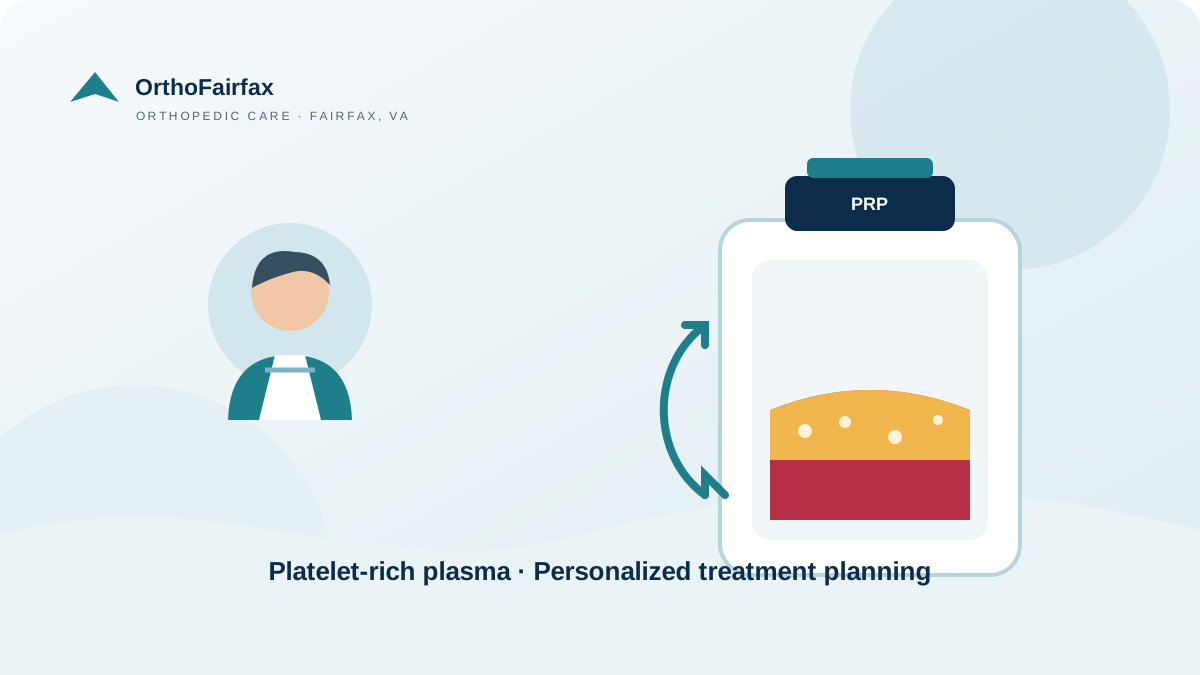
Platelet-rich plasma is created from a small sample of a patient's own blood. The sample is processed to concentrate platelets in plasma; platelets release growth factors and other signaling proteins involved in the body's normal healing response. PRP uses the patient's own biological material, rather than being a conventional steroid medication. Its purpose is to influence the local tissue environment—not to guarantee repair or reverse every injury.
The power of PRP is best understood as a treatment tool that can be considered as part of a precise, diagnosis-led plan. It is not a one-size-fits-all injection. The condition being treated, the severity and duration of symptoms, the preparation method, rehabilitation, and the patient's overall health all matter.
Why diagnosis and MSK ultrasound matter
Successful orthopedic care starts with identifying the structure causing symptoms. OrthoFairfax uses clinical examination and musculoskeletal ultrasound when appropriate to assess tendons, muscles, ligaments, bursae, and other accessible structures in real time. Ultrasound can help distinguish different sources of pain and show the clinician the target anatomy. For selected PRP procedures, ultrasound guidance can help visualize the needle and guide placement toward the intended area.
MSK ultrasound is a practical advantage in a sports medicine setting: it provides dynamic, real-time assessment without ionizing radiation and can complement—not replace—a history, physical examination, or other imaging when indicated. Not every condition is fully assessed with ultrasound, and the clinician determines which imaging approach is appropriate.
Where is PRP used in orthopedic care?
PRP is studied and used for selected tendon disorders and knee osteoarthritis, among other musculoskeletal conditions. Evidence differs by diagnosis, and research findings are not uniform. In a consultation, the important question is not simply whether PRP is popular; it is whether the available evidence supports considering it for this specific problem and what outcome is realistic.
PRP for tendon injuries and active patients
Persistent tendon pain can interfere with work, exercise, sport, and ordinary activities. For a properly diagnosed tendon condition, a treatment plan may combine load management, rehabilitation, a review of contributing factors, and selected procedures. PRP can be discussed in appropriate cases as one part of that plan. A partial tendon tear, complete rupture, and chronic tendinopathy are different problems and must not be treated as interchangeable diagnoses.
PRP and knee osteoarthritis
People living with knee osteoarthritis often want to walk farther, climb stairs more comfortably, and stay independent. PRP is an option patients may ask about, and some studies report symptom improvement. However, preparation methods and studies vary, professional recommendations are not uniform, and PRP is not proven to regrow cartilage or reverse arthritis. We believe patients deserve a clear explanation of the evidence, expected costs, alternatives, and uncertainty before choosing treatment.
What to expect at OrthoFairfax
- Understand the problem. We begin with your history, goals, physical examination, and review of prior treatment.
- Use imaging thoughtfully. MSK ultrasound can help evaluate selected structures and may guide an injection when clinically appropriate.
- Build an individualized plan. We discuss conservative care, rehabilitation, medications, injection options, and referral or surgical evaluation when needed.
- Set realistic expectations. We review the evidence, risks, recovery considerations, cost, and how progress will be assessed.
Benefits, risks, and honest expectations
PRP is not guaranteed to work and is not right for every diagnosis. Temporary pain, swelling, bruising, bleeding, infection, cost, and time away from certain activities are among the considerations. Insurance coverage varies and patients should confirm costs before treatment. A clinician should review medications, health conditions, and alternatives before proceeding.
Our approach is straightforward: strong orthopedic assessment, the right imaging for the question, and a plan built around the person—not a promise that one injection fixes everything. OrthoFairfax brings orthopedic and sports medicine expertise to patients in Fairfax, Virginia, with a focus on helping people understand their options and return to meaningful activity.
Explore next: PRP therapy at OrthoFairfax, musculoskeletal ultrasound, and knee osteoarthritis treatment options.
Medical information: This article is educational and does not replace an individual evaluation. PRP evidence and recommendations vary by diagnosis; a clinician should determine whether it is appropriate for a particular patient.