
Start with the reason your knee hurts
Knee pain may come from osteoarthritis, tendon or bursa problems, an injury, or another condition. Treatment should follow a careful examination rather than assuming every painful knee needs the same injection. OrthoFairfax combines orthopedic and sports medicine assessment with musculoskeletal (MSK) ultrasound when it can answer a focused question about accessible soft-tissue structures. X-rays or other imaging may be needed to evaluate joint arthritis or other problems.
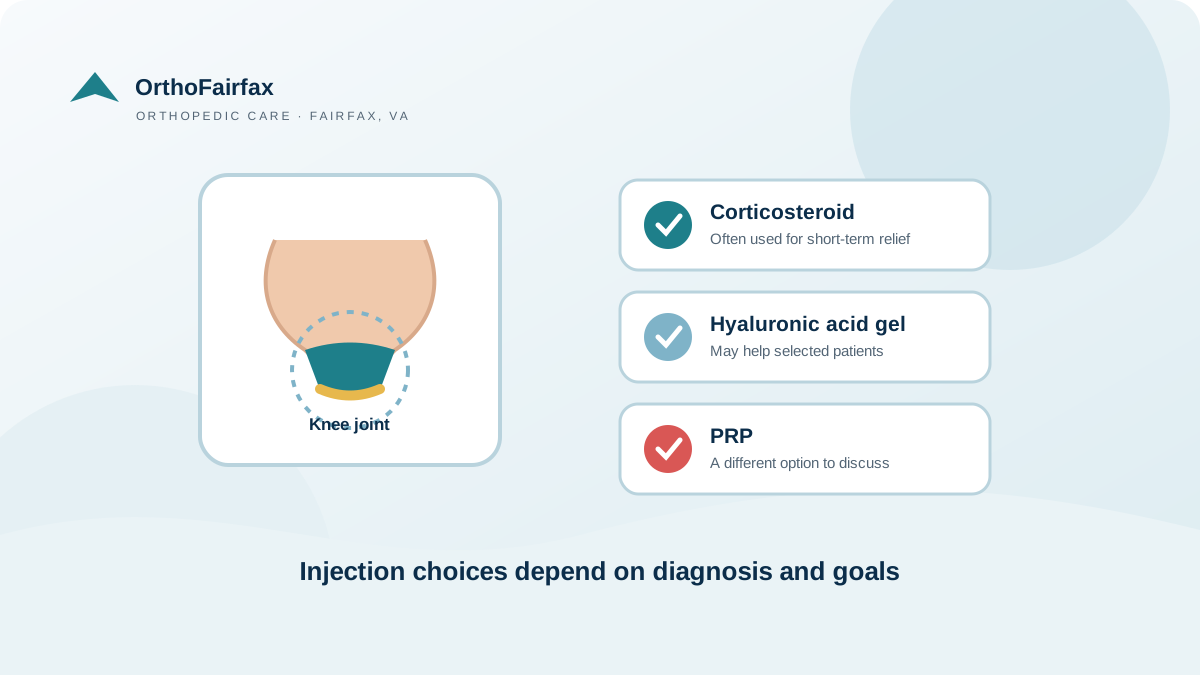
Corticosteroid (steroid) injections
A corticosteroid injection is intended to reduce inflammation and can provide short-term symptom relief for some people with knee osteoarthritis, particularly during a flare. The amount and duration of relief vary. Steroids do not rebuild cartilage or reverse arthritis. Potential risks include temporary post-injection soreness and a rise in blood glucose in people with diabetes; the benefits and risks of repeated injections should be discussed with the treating clinician.
Hyaluronic acid gel injections
Viscosupplementation, often called a gel injection, places a hyaluronic-acid product into the knee joint. It is intended to improve symptoms, but study results are mixed and clinical guidelines differ. Some patients report improvement; others have little or no benefit. Products and schedules vary, and insurance authorization and patient cost should be checked before treatment. Gel injections do not replace lost cartilage.
PRP: another option to discuss
Platelet-rich plasma is prepared from a patient's own blood and is used in selected musculoskeletal treatment plans. Some studies in knee osteoarthritis report improvements in symptoms, but evidence and recommendations remain variable. PRP is not a guaranteed solution or a proven way to regrow cartilage. It may be an option to discuss after reviewing the diagnosis, evidence, cost, risks, and alternatives.
At a glance
- Steroid: often considered for short-term symptom relief; not a cartilage-restoring treatment.
- Gel: hyaluronic acid injection with mixed evidence and differing guideline recommendations.
- PRP: blood-derived platelet concentrate; growing but variable evidence and often different coverage or cost considerations.
- MSK ultrasound: can help assess selected soft-tissue structures and guide certain injections when clinically appropriate; it is not itself a treatment for arthritis.
Why injection technique and evaluation matter
For selected injections, ultrasound guidance allows the clinician to visualize relevant anatomy and the needle in real time. It can be particularly useful when targeting certain soft-tissue structures or when anatomy makes guidance valuable. The choice to use ultrasound depends on the procedure and clinical situation; image guidance improves visualization but cannot promise symptom relief.
What should you choose?
There is no single best injection for every knee. Consider pain pattern, examination and imaging findings, health conditions, prior response, activity goals, coverage, and the quality of evidence for the proposed treatment. Exercise, physical therapy, activity modification, and medication when safe may remain important regardless of injection choice. Ask what happens if an injection does not help and when the plan should be reassessed.
At OrthoFairfax, we focus on orthopedic and sports medicine care that matches the treatment to the problem. Patients in Fairfax and Northern Virginia can discuss knee arthritis, MSK ultrasound, steroid injections, gel injections, PRP, and other appropriate non-surgical options during an evaluation.
Explore next: knee osteoarthritis in older adults, the power of PRP, and ultrasound-guided injections.
Medical information: General education only, not individual medical advice. Risks, recommendations, and insurance coverage vary; discuss your personal circumstances with a qualified clinician.